


Among the princes of the House of Liechtenstein, Joseph Wenzel I (1696–1772) ranks as one of the sovereigns who—through his work as a military commander, diplomat, reformer, and not least as a patron and collector of art—left perhaps the most distinct mark of his reign. Yet, he was not originally destined to lead the fates of the House of Liechtenstein as the majorat lord. Twice he had to manage the family affairs as a guardian following the premature deaths of the ruling princes until their successors reached maturity. It was only the third time, in 1748, that he could assume the majorat permanently and hold it until his death. This also granted him the financial means to realize extensive building projects, purchase exceptionally significant works of art, and finance costly projects for the imperial court.
His endeavour to shape his own living environment led to the creation of important architectural monuments. Maria Theresa of Austria, Archduchess of Austria and Queen of Hungary and Bohemia, held the modernized chateau in Valtice, which had been modified by his interventions, in exceptionally high regard. His refined taste was also significantly evident at the chateaus in Wilfersdorf and Ebergassing.
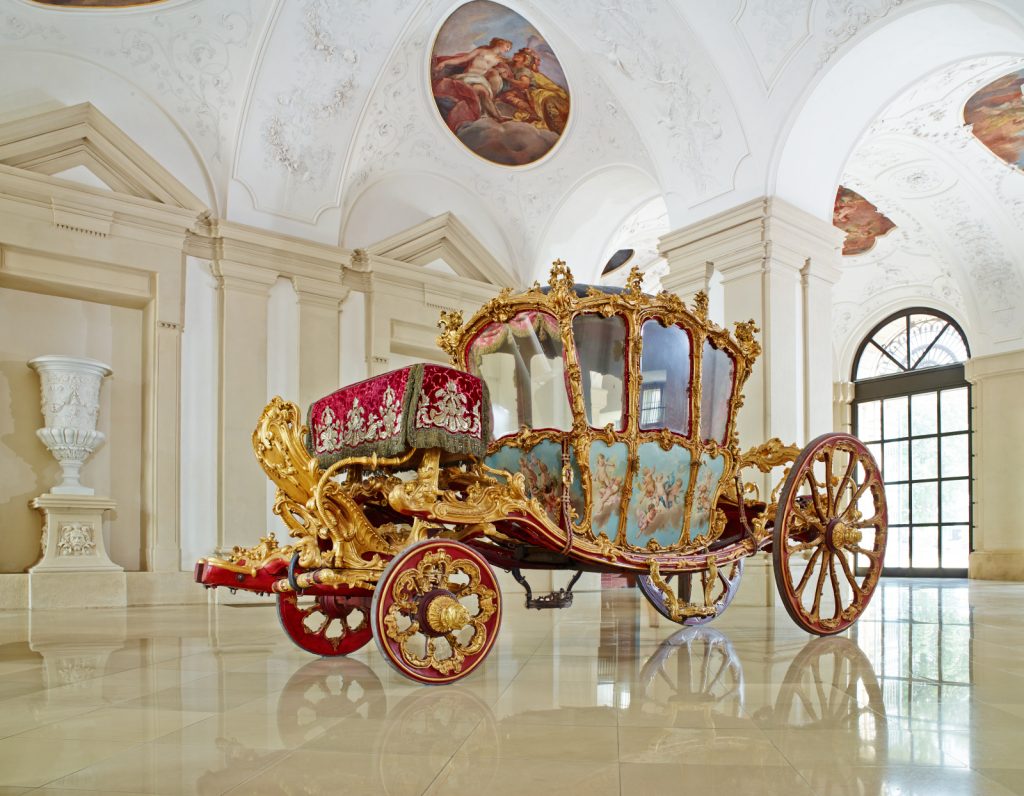
However, the most significant work of art created upon his commission is the Golden Carriage—one of the few surviving examples of 18th-century ceremonial carriage art. The impetus for its creation was the appointment of Prince Joseph Wenzel I as the Imperial Ambassador to the French court. The carriage was created for the ceremony of the solemn entrée into Paris (Louvre) and Versailles. The designation “Golden Carriage” did not appear, however, until the 19th century, when carrosses inspired by French fashion were gradually replaced by predominantly dark carriages following new English models.
On November 7, 1737, Joseph Wenzel received imperial instructions to travel to Paris as an ambassador of the House of Habsburg. The goal of his mission was to confirm the treaties negotiated and accepted in Europe regarding the Pragmatic Sanction, which ensured the continuation of the Habsburg line even through the female line. Only after the end of the War of the Polish Succession, which concluded with the Treaty of Vienna on November 18, 1738, could he definitively take up his post in Paris. In the period between his appointment and his official inauguration, the ceremonial entrée into Paris was prepared.
Architect Nicolas Pineau (1684–1754), who had previously worked at the court of Tsar Peter I in St. Petersburg, was commissioned to design five ambassadorial carriages (carrosses d’ambassadeur)—four silver and one gilded; only the Golden Carriage has been preserved.
The carriage belongs to the berline type, and through its delicate morphological language, it represents the transition from High Baroque to Rococo. The painted decoration, created under the direction of François Boucher (1703–1770), depicts playing putti symbolizing the four elements and the four seasons. The decorative elements were partly carved from wood and partly cast in fire-gilded bronze, contributing to the vehicle’s extraordinary weight.
During the princely parade, the Golden Carriage was the fourth of five teams, each drawn by eight horses from the princely stud farm in Lednice. It represented the pinnacle of the entrée publique on December 21, 1738, in Paris and two days later in Versailles. The elegance of the harmoniously coordinated ensemble of carriages, harnesses, and horses—as an expression of the highest representation—enthralled even the demanding Parisian public; the event was reported by both Mercure de France and Wienerisches Diarium.
Along with the Prince, the Golden Carriage returned to Vienna. When Archduke Joseph (later Emperor Joseph II, 1741–1790) became engaged to Princess Isabella of Parma (1741–1763) in 1760, Joseph Wenzel was assigned the honourable but exceptionally costly duty of escorting the bride from Parma to Vienna. In both locations, the carriage was again the highlight of the festivities. Before the journey, the vehicle had to be expensively restored—in Vienna, the textiles and cut crystal glass panes were replaced.
For the journey to Parma, the carriage was transported disassembled; thanks to a surviving diary, we know the circumstances of its transport down to the last detail. Ingenious logistics ensured a safe move to Parma and back. There was no hesitation even to undermine city gates or remove oriel windows to make passage possible. The actual ride in the carriage took place only over short sections during the departure from Parma and the arrival in Vienna; these moments are captured in monumental paintings that document the opulence of this politically arranged wedding in detail.
The Golden Carriage experienced one more historically significant deployment in 1764, when Prince Joseph Wenzel served as the First Imperial Commissioner during the election and coronation of the heir to the throne, Archduke Joseph, as King of the Romans in Frankfurt am Main.
The Golden Carriage:
François Boucher (1703–1770), Nicolas Pineau (1684–1754)
The Golden Carriage of Prince Joseph Wenzel I of Liechtenstein, 1738
LIECHTENSTEIN. The Princely Collections, Vaduz–Vienna