


For centuries, the history of Břeclav has been inextricably linked with the Liechtenstein family, one of the most important and influential noble families in Central Europe. The first written records of this family date back to the 12th century, when Hugo von Liechtenstein resided in Mödling near Vienna and owned extensive estates north and south of the Danube. Over time, the family grew, divided into individual lines, and systematically expanded its holdings in Moravia, Lower Austria, and other parts of the Habsburg Monarchy.
A major turning point came in the 13th century, when the Liechtensteins acquired Mikulov, laying the foundations for the Mikulov line, which became the bearer of their power in southern Moravia. Břeclav, then known by its German name Lundenburg, came into their possession in 1384, when the Moravian Margrave Jošt sold it to the brothers Hanuš, Hartnaid, and Jiří of Liechtenstein. From then until the second half of the 16th century and until 1638, Břeclav became an integral part of the Liechtenstein estate and shared its political, economic, and cultural development with the family.
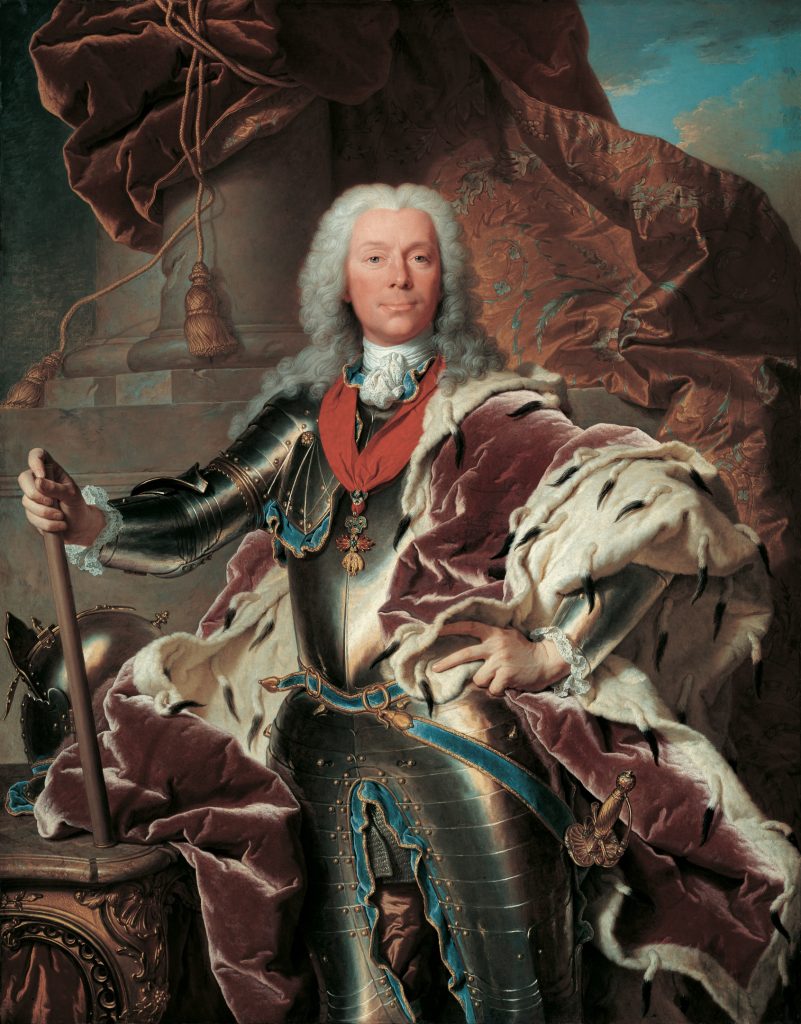
An important figure in this history was Prince Joseph Wenzel I, imperial marshal, diplomat, army reformer, and ruler of the independent state of Liechtenstein. He was born on August 9, 1696, in Prague as son of Philip Erasmus of Liechtenstein. His father died in 1704 during military campaigns in northern Italy, which significantly influenced the future life of young Joseph Wenzel, who grew up in the shadow of his family’s military tradition.
He studied at the Latin school at Collegium Carolinum (these days Charles University) in Prague and was prepared for service in the Habsburg monarchy from a young age. Although he came from a secondary line of the family, he spent a considerable amount of time at Břeclav Castle, which became a place close to his heart. It was here that he found peace away from the hustle and bustle of the courts in Vienna and Prague.
He began his career in the imperial army, where he gradually rose to the highest military ranks. As a commander, he became famous for his victory at Piacenza in 1746, where he defeated the combined French and Spanish armies. In addition to his military command, he also served as a diplomat in Berlin and Paris. At the same time, he contributed to the modernization of artillery when he founded an artillery school with his own funds and reorganized the monarchy’s armament system.
His exceptional position at the imperial court is also evidenced by a ceremonial task in 1760, when he was entrusted with accompanying the bride of the future Emperor Joseph II, Princess Isabella of Parma, on her journey to Vienna. This extremely costly and prestigious event became one of the highlights of court ceremony of its time. For this occasion, the famous golden carriage was made in Paris, a symbol of the princely prestige, wealth, and political importance of the Liechtenstein family, which is now on display in the Liechtenstein Garden Palace in Vienna.
After the death of Prince Joseph Johann Adam in 1732, Joseph Wenceslas became the guardian of the minor heir John Nepomuk Charles and the factual administrator of the extensive family estate. After his death in 1748, he assumed full responsibility for the family and the Liechtenstein state. To prevent family conflicts, he established a secundogeniture for his brother Emanuel, while retaining Břeclav as his personal residence.
Joseph Wenzel I was also a prominent patron of the arts and charity. He supported war widows, founded social institutions, and collected art. Angelo Soliman, an important figure in 18th-century cultural life, also worked at his court. Joseph Wenzel I died on February 10, 1772, in Vienna and was buried in the family tomb in Vranov u Brna. Empress Maria Theresa said of him that he was “one of those people you won’t find again” – a statement that aptly sums up his importance for the history of the family and the town of Břeclav.
Paiting:
Joseph Wenzel I, Prince of Liechtenstein
Author: Hyacinthe Rigaud – Museum, public domain, source: Wikipedia