


Lednice-Valtice area with its chateau gardens, sallets, and bosquets, is a direct invitation for strolls and gallant conversation à la française. We associate gallantry with French aristocratic society, which adopted it as its lifestyle in the 17th century—a time when the model of the gallant nobleman supplanted the older ideal of the honorable nobleman. On the road from Lednice to Valtice stands the Temple of Apollo, dedicated to the god of the sun, music, poetry, and art. Beholding the radiant god on a chariot drawn by a four-horse team brings to mind one of the most gallant and musical of French kings, Louis XIV, known as the Sun King and depicted as Apollo following his grandiose performance in 1653 in the Ballet de la Nuit. Only fifteen at the time, Louis danced in a solar costume encrusted with gems and gold, accompanied by Aurora and surrounded by courtiers, the Genii, paying him homage.
With the reign of Louis XIV, the “Golden Age” of France began. At the French court, music was everyday and omnipresent. Both the daily routine and extraordinary events unfolded to its rhythm. It was played during the King’s lever and coucher, accompanied divine services, and graced royal festivities; it enhanced the luster of ceremonies or provided diversion for the monarch and courtiers in their privacy, whether in salons or during strolls. The Sun King sought to extend his political and economic dominance into the artistic realm to consolidate his own power. The dance he loved so much was elevated to an aristocratic art par excellence. The founding of the Académie Royale de Danse (1661) and the Académie Royale de Musique (1669) attests to his immense interest in the arts. Every evening except Saturday, concerts were held in the royal apartments featuring royal musicians. He spurred the development of many musical genres (motet, tragédie lyrique, cantata, symphonie). In his service were over 150 official musicians—by 1715, as many as 200—who were titled Musiciens du Roi or Officiers de la Maison du Roi. Instrumentalists were named Violon de la chambre du Roi or Hautbois du Roi.
Music at the court of Louis XIV was divided into three great institutions: Musique de la Chapelle Royale, Musique de la Chambre, and Musique de la Grande Écurie. It was performed primarily at the Palace of Versailles, an architectural masterpiece where the hallmarks of French Classicism merge with the powerful effects of Baroque scenography. Two additional orchestras functioned at Versailles: 24 Violons du Roi (or Grand Bande) and Petits Violons du Roi (also called the Petite Bande). Louis XIV provided many opportunities for composers and musicians, yet simultaneously and repeatedly restricted their efforts with his personal demands. The royal musicians gathered on Wednesdays, Fridays, and Sundays for grand musical performances, and on Tuesdays and Thursdays for chamber appearances; they accompanied the King on his frequent travels, especially to Fontainebleau. The King demanded novelties and fast, cheerful music, although in the final years of his life, when melancholy set in, his soul was comforted by an entirely different type of music, above all by bittersweet airs.
For nearly 200 years, airs de cour served as the primary source for French vocal production. They were an essential ornament of royal entertainments and court ballets, and were highly popular in literary, aristocratic, and bourgeois circles. This genre of composition became the main output of French composers and musicians, particularly in the mid-17th century. At that time, the French song or air—an expression of French musical sensibility—reached its peak in the works of Michel Lambert, Étienne Boësset, Bertrand de Bacilly, and others. The air was first performed in the fashionable Parisian salons where the arts of conversation and gallantry were cultivated. Later, thanks to the prints of the Ballard family, these songs spread among the music-loving public; simpler, “sweeter” songs were added to the courtly airs, featuring more frequent references to springtime nature, the singing of birds, and gentle breezes. In airs sérieux, they sang of pellucid fountains, terrifying rocks, faithful lovers, shepherds, and nightingales, while in airs à boire, they celebrated Bacchus, superficial love, and fleeting joys.
Of the vast number of short airs sérieux, airs à boire, and airs tendres (also known as brunettes) that were published monthly by the famous publisher Ballard and functioned much like popular songs do today, only a handful are known nowadays. The popularity of these short ditties led composers such as Hotteterre, Montéclair, or Boismortier to arrange them for solo flute. Most of Hotteterre’s ornamented versions were published with the text, which served as a guide for correct interpretation, a reminder of the song’s origin, and a script for singers in joint performances. The lyrics of airs sérieux deal almost exclusively with the unrequited love of shepherds for charming shepherdesses who are indifferent to their feelings or perhaps merely feigning lack of interest. Occasionally, a specific genre evolved—the Brunette, named after the lyrics of the song Le beau Berger Tircis: “Ah! petite Brunette, Ah! tu me fais mourir.”
As with other pastoral genres in France at that time, the simplicity of these ditties is apparent and, moreover, quite deceptive. The fashion for genre paintings, pastoral plays and operas, songs, costumes, and instruments (such as the musette) originating from the pastoral idyll is nothing more than an idealized version of rural life, which managed to strike a sensitive chord with Parisians and courtiers at Versailles. Under the mask of a lamenting shepherd, singers could give free rein to their disappointed desires. Beyond circles close to the court, airs sérieux were a popular entertainment for the middle class, as they allowed the educated Parisian to enjoy the same music that moved the court nobility.
Musical life at Versailles elevated concerts to the level of official entertainment with a significant social role. Without them, such an expansion of concert life outside the court would likely not have occurred. With the founding of the Concert Spirituel by Anne Danican Philidor several decades later, in 1725, Paris gained its first regular public concerts in the modern sense of the word. Also, the wife of Louis XV, Queen Marie Leszczyńska, took over the proverbial baton from the Sun King and organized both chamber and grand concerts. In the second half of the 18th century, she was followed by the King’s chief mistress, Madame de Pompadour, Dauphine Marie-Josèphe of Saxony and Queen Marie Antoinette. They all built upon the concept of “divertissement” created by Louis XIV.
While for Louis XIV art and power were inseparable, several generations later Marie Antoinette showed that music does not have to have anything to do with politics. From the estate of the ill-fated Queen Marie Antoinette—who hosted the best musicians of her time in her salons and who herself loved singing and played the harp and harpsichord excellently—Prince Alois I of Liechtenstein acquired rare silk wallpapers in the early 19th century for the Belvedere summer house, which stands on Fox Hill near Valtice and looks out over a bucolic landscape reminiscent of Watteau’s galante paintings.
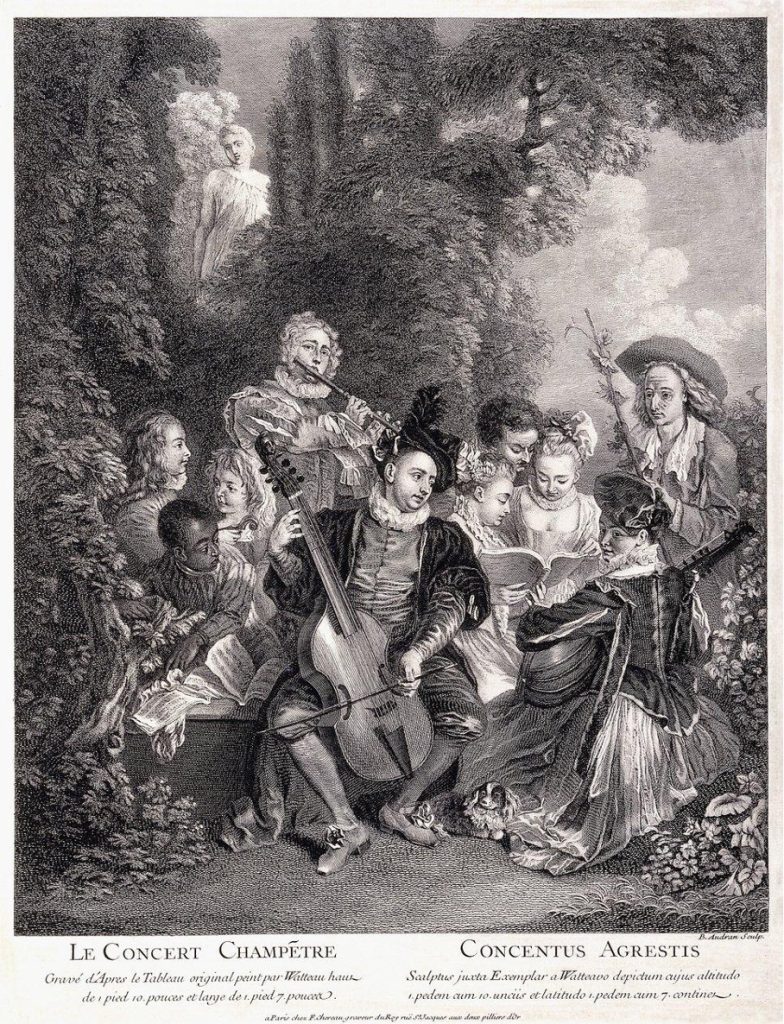
Paiting:
Benoît Audran after Watteau, Le Concert Champêtre, engraving, c. 1727